
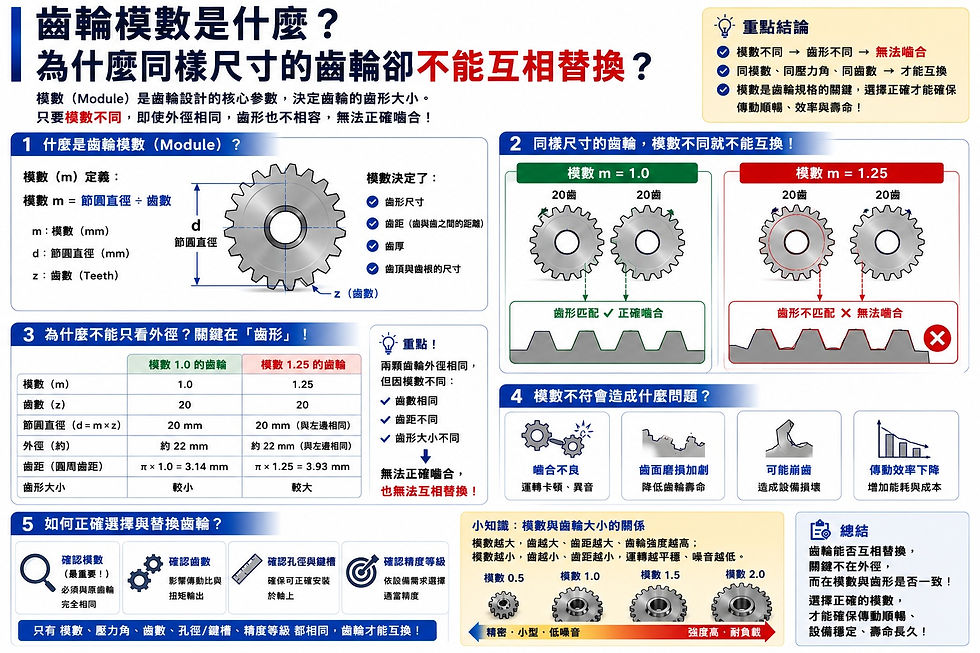
What Is Gear Module? Why Can't Gears of the Same Size Always Be Interchanged?

Updated: Oct 18
In the previous articles, we introduced the fundamentals of gears, common gear types, material selection, and the applications of micro gears in robots and drones.
However, when selecting or designing gears, many people often encounter the following question:
Why do two gears that appear to be almost the same size—even with the same number of teeth—not work properly when installed together?
In reality, whether two gears can mesh correctly is not determined solely by their outside diameter.
Besides the number of teeth, you must also verify:
Gear Module
Pressure Angle
Gear Accuracy Grade
Applicable Standards
Among these factors, gear module is the most critical.
---
1. Why Can't Gears with Similar Dimensions Be Directly Replaced?
In practice, many people first measure the outside diameter of a gear and then look for a replacement with a similar size.
However, even if two gears have:
Nearly identical outside diameters
The same number of teeth
Similar thickness
they are not necessarily compatible.
If their module or pressure angle differs, the tooth profile will also differ.
Even if they can be assembled by force, problems such as the following may occur:
Poor gear meshing
Abnormal operating noise
Accelerated wear
Reduced transmission efficiency
Tooth surface damage
Therefore, engineers never determine gear compatibility based solely on external dimensions.
---
2. What Is Gear Module?
Gear module (Module, abbreviated as m) can be understood as the standard measurement that defines the size of a gear tooth.
The module determines the size of every tooth on the gear.
A larger module means:
Larger teeth
Greater tooth spacing
Generally higher load-carrying capacity
A smaller module means:
Smaller teeth
Narrower tooth spacing
Better suited for compact and precision applications
The module is calculated using the following formula:
Module (m) = Pitch Diameter ÷ Number of Teeth
For example:
Pitch Diameter: 20 mm
Number of Teeth: 20
Therefore:
20 ÷ 20 = 1
This is commonly referred to as a Module 1 gear.
Common gear modules include:
Module 0.2
Module 0.3
Module 0.5
Module 1
Module 1.5
Module 2
Among them, Module 0.5 and Module 1 gears are widely used in many types of machinery.
---
3. What Happens If the Module Is Different?
Even if two gears have the same number of teeth, different modules result in completely different gear sizes.
Taking a 20-tooth gear as an example:
Module | Number of Teeth | Pitch Diameter |
0.5 | 20 | 10 mm |
1 | 20 | 20 mm |
2 | 20 | 40 mm |
As shown above:
Although all three gears have 20 teeth, a larger module results in a larger overall gear size.
Therefore:
A Module 1 gear cannot mesh with a Module 0.5 gear
A Module 2 gear cannot mesh with a Module 1 gear
because both the tooth spacing and tooth profile are completely different.
This is the first and most important specification to verify when selecting gears.
---
4. If the Module Is the Same, Are the Gears Always Interchangeable?
Not necessarily.
Many people assume that gears with the same module can always replace one another.
In reality, another critical parameter must also match:
Pressure Angle
Even if the module is identical, gears with different pressure angles may still fail to mesh correctly.
For this reason, engineering drawings typically specify both:
Module
Pressure Angle
Missing either specification can easily result in selecting the wrong gear.
---
5. What Is Pressure Angle?
The pressure angle is one of the most important parameters in gear design.
Simply put, it represents the direction in which force is transmitted between meshing gear teeth.
Although it is difficult to distinguish visually, the pressure angle directly affects:
Load capacity
Transmission efficiency
Contact characteristics
Service life
20° Pressure Angle
The most common standard today is the 20° pressure angle.
Most modern gear designs adopt a 20° pressure angle because it offers:
Higher tooth strength
Better load-carrying capacity
Industry-standard compatibility
14.5° Pressure Angle
The 14.5° pressure angle is an older design standard.
Although it is less common today, it can still be found in certain older equipment, imported machinery, and specialized applications.
Therefore, gears should never be replaced simply because their dimensions appear similar.
---
6. What Is the Difference Between a 20° and a 14.5° Pressure Angle?
Item | 20° Pressure Angle | 14.5° Pressure Angle |
Popularity | Current industry standard | Older specification |
Tooth Root Strength | Higher | Lower |
Load Capacity | Better | Lower |
Typical Applications | Modern equipment | Older machinery |
Market Availability | Widely available | More limited |
Unless there is a specific requirement, most modern engineering designs prioritize gears with a 20° pressure angle.
---
7. What Are JIS, DIN, and AGMA?
Besides module and pressure angle, gears are also manufactured according to different national and industrial standards.
Common standards include:
Standard | Country / Organization | Full Name |
JIS | Japan | Japanese Industrial Standards |
DIN | Germany | Deutsches Institut für Normung |
AGMA | United States | American Gear Manufacturers Association |
These standards may specify different requirements for:
Dimensional tolerances
Accuracy grades
Inspection methods
Therefore, when sourcing gears internationally or replacing components during maintenance, verifying the applicable standard is also an important step.
---
8. What Is Gear Accuracy Grade?
Sometimes two gears have:
The same module
The same number of teeth
The same material
yet their prices differ significantly.
One of the main reasons is gear accuracy grade.
Gear accuracy directly affects:
Smoothness of operation
Noise level
Transmission efficiency
Service life
Higher gear accuracy generally means:
More difficult machining
Stricter inspection requirements
Higher manufacturing costs
Therefore, industries such as robotics, semiconductor equipment, and precision automation typically require gears with higher accuracy grades.
---
9. Gear Specification Checklist
When purchasing or replacing a gear, it is recommended to verify at least the following specifications:
Item to Verify | Description |
Module | Determines the size of the gear teeth |
Number of Teeth | Determines the gear ratio |
Pressure Angle | Determines the meshing characteristics |
Material | Affects strength and durability |
Accuracy Grade | Influences performance and service life |
Applicable Standard | JIS, DIN, AGMA, etc. |
If any of the above information is missing, it is not recommended to replace a gear simply because it looks similar.
---
10. Why Choose Sheng Fong Precision?
Selecting a gear involves much more than simply matching its dimensions.
In actual applications, engineers must also consider:
Module
Pressure angle
Number of teeth
Material
Accuracy grade
Operating environment
Sheng Fong Precision provides a wide range of mechanical components and integrated supply chain services, helping customers evaluate the most suitable parts for different applications.
If you have requirements for gears, power transmission components, or related mechanical parts, feel free to contact us for consultation.
LINE: @s9000
Learn more about our mechanical components and custom manufacturing services:
🔎 Check sizes and stock on the SFP hardware parts platform: Machine Keys
#GearModule#WhatIsModule#GearSpecifications#GearModuleCalculation#Module1Gear#Module0_5Gear#20DegreePressureAngle#20DegreePressureAngleGear#14_5DegreePressureAngle#14_5DegreePressureAngleGear#JISGear#DINGear#AGMAGear#GearAccuracyGrade#MechanicalComponents#ShengFongPrecision#SFP


Comments