
Why Do Some Components Use 416 While Others Specify 440C?The Key Difference Between Machinability and Wear Resistance

When selecting stainless steel materials for components, many people first focus on corrosion resistance. However, for mechanical parts, the characteristics of the material itself often have a greater impact on machining methods, service life, and overall cost.
Particularly in dowel pins, shafts, cutting tools, screws, and precision components, both 416 and 440C are common stainless steel grades. However, their intended applications are fundamentally different.
Some products require:
Higher hardness
Better wear resistance
Long-term dimensional accuracy
Others prioritize:
Machining efficiency
Stable mass production
Reduced manufacturing costs
This is the biggest distinction between 416 and 440C.
---
1. Why Do Two Stainless Steels Have Such Different Applications?
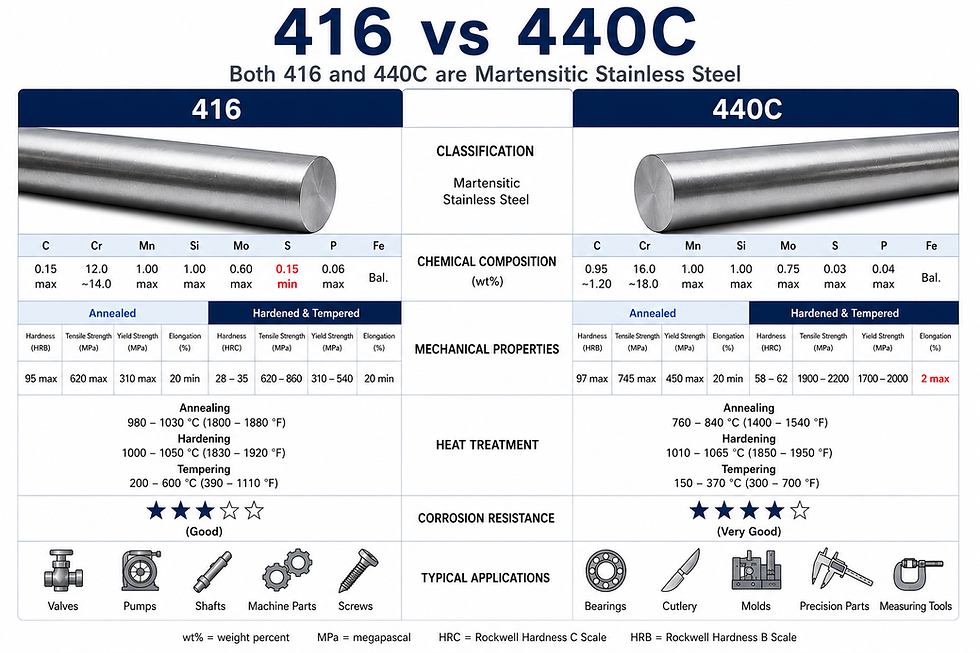
Both 416 and 440C belong to the family of Martensitic Stainless Steels.
Key characteristics of martensitic stainless steels include:
Heat treatable
Magnetic
Capable of achieving high hardness
Widely used in mechanical components
Although they belong to the same stainless steel family, they were designed with different priorities.
416 focuses more on:
"Ease of machining and high-volume production."
440C focuses more on:
"High hardness and excellent wear resistance."
As a result, they are rarely interchangeable in practical applications.
Material selection is not simply about choosing the higher-grade material. Instead, it depends on what the product actually requires:
Machining efficiency
Wear resistance
Service life
Cost control
Different requirements lead to different material choices.
---
2. Why Is 416 Commonly Used in CNC Machined Parts?
The biggest advantage of 416 stainless steel is its excellent machinability.
It is classified as a Free-Cutting Stainless Steel. By adding sulfur to the material, cutting resistance is reduced, making turning, milling, and tapping easier.
For this reason, 416 is extremely common in CNC machining operations.
For manufacturers, machinability directly affects:
Tool life
Machining speed
Production consistency
Manufacturing cost
Its advantages become even more significant in automatic lathes and high-volume production environments.
Common Advantages of 416
Stable turning performance
Lower tool wear
Faster machining speeds
Suitable for mass production
Easier cost control
Typical Applications of 416
Application Category | Common Products |
Turned Components | Shafts, connectors |
Fasteners | Screws, nuts |
CNC Machined Parts | Precision mechanical components |
Automatic Lathe Parts | Small metal components |
---
3. Why Is 440C Commonly Used in High-Precision Components?
The most well-known characteristics of 440C are its high hardness and excellent wear resistance.
440C is a high-carbon martensitic stainless steel. After heat treatment, its hardness typically reaches approximately HRC 58–60, making it ideal for high-wear environments.
Compared with 416, 440C is more like:
"A stainless steel with tool-steel characteristics."
It is commonly used for parts that require:
Continuous friction resistance
Long-term dimensional stability
High hardness support
Typical examples include:
Precision dowel pins
Bearing components
Industrial cutting tools
High-wear mechanical parts
Common Advantages of 440C
High hardness
Excellent wear resistance
Suitable for high-load applications
Maintains dimensional stability over long periods
Typical Applications of 440C
Application Category | Common Products |
Precision Components | Dowel pins, bearings |
Cutting Tools | Industrial blades, cutting tools |
High-Wear Parts | Valve components, wear-resistant assemblies |
High-Precision Components | Precision mechanical assemblies |
---
4. Higher Hardness Is Not Always Better
Many people instinctively believe:
"The harder the material, the better."
However, increased hardness generally comes with increased machining difficulty.
For example, after heat treatment, 440C offers outstanding wear resistance but may also result in:
Longer machining times
Faster tool wear
Higher manufacturing costs
More difficult surface finishing processes
Therefore, not every product is suitable for 440C.
If the component:
Does not require extreme wear resistance
Is not exposed to continuous friction
Does not operate under high loads
Then 416 is often the more practical and efficient choice.
---
5. Why Do Many Mass-Produced Parts Prefer 416?
For mass production, machining efficiency itself is part of the overall cost.
Even if a harder material provides better performance, it may also cause:
Reduced machining speed
More frequent tool replacement
Higher production costs
Longer lead times
Because of its excellent machinability, 416 is extremely common in high-volume turned components.
Especially in:
Automatic lathes
CNC turning operations
Small precision components
416 is often the preferred material.
This explains why many mechanical components continue to use 416 even when 440C offers superior performance.
Material selection involves more than performance alone. It also includes:
Production efficiency
Process stability
Cost management
---
6. Comparison Between 416 and 440C
Item | 416 Stainless Steel | 440C Stainless Steel |
Material Type | Free-Machining Martensitic Stainless Steel | High-Carbon Martensitic Stainless Steel |
Machinability | Excellent | More Difficult |
Hardness | Medium to High | Very High |
Wear Resistance | Moderate to Good | Excellent |
Heat Treatment Response | Increased Hardness Possible | Greater Hardness Increase |
Cost | Lower | Higher |
Best For | High-Volume Machining | High-Wear Applications |
Common Uses | Turned Parts, Screws | Dowel Pins, Bearings |
---
7. How Should You Choose Between 416 and 440C?
A practical way to select the material is to start from the application requirements.
Material Selection Guide
Requirement | Recommended Material |
High-Volume Production | 416 |
Lower Machining Cost | 416 |
CNC Turned Components | 416 |
Automatic Lathe Production | 416 |
High Hardness Requirement | 440C |
High Wear Resistance Requirement | 440C |
Precision Positioning | 440C |
Long-Term Friction Contact | 440C |
---
8. Why Choose Sheng Fong Precision?
Different stainless steel grades represent more than just different material names. They also affect machining methods, service life, and overall manufacturing cost.
Sheng Fong Precision provides various stainless steel dowel pins, precision components, and CNC-machined parts. We assist customers in evaluating:
Material selection
Heat treatment requirements
Machining methods
Tolerance and fit requirements
We support both standard products and custom manufacturing solutions.
If you have drawings, samples, or application requirements, we can help recommend the most suitable material and machining process.
LINE: @s9000
View Dowel Pin Specifications:https://www.sfp-tw.com/pin


Comments